
by Bud F | Jul 31, 2020 | Uncategorized
COVENANTS AND SALVATIONS HISTORY
The Bible is a love story – the tale of God who loves us so much that he came to us – the lost souls – to save us through great sacrifice. “Scripture records the highlights of a divine drama.” The prophetic nature of scripture needs to be understood as it is, “the covenantal pattern of divine justice and mercy.” Through a series of covenants, God move from dealing with Adam and Eve to dealing with the entire world.
A covenant is similar to a contract, but in fact is greatly different. A contract is made with a promise or pledge for the exchange of goods. A covenant is the extension of kinship by oath, an oath made by invoking God’s name.
There were five major covenants in the Old Testament, all of which are fulfilled in the final one, the New and Everlasting Covenant as the priest says in Mass. Testamentum(sp) was use the Latin translation of the word, covenant, by St Jerome when he translated Greek bible. So that part of the scripture came to be called the New Testament. Understanding the covenantal development of the bible story helps us understand why the Old Testament is so long.
The covenants are named for the mediator, the one who was speaking to God about the terms of the covenant. Here they are:
1. The Covenant with Adam – Adam was to till and keep the Garden of Eden, named and was given dominion over all of them, and was given a wife in a marriage covenant. All the plants in the garden were theirs to eat, except one. (family)
2. The Covenant with Noah – God promised to save Noah and his sons and their family from the flood in return for building an ark and saving the animals. (extended family)
3. The Covenant with Abraham (3 promises) – God promised Abraham a “Land of Milk and Honey” where his descendants would be a blessed nation, then a kingdom, and then all the families on earth would be blessed by him and his seed. (tribe)
4. The Covenant with Moses – Moses was called to lead his people out of bondage, to ratify a national covenant that made them a Holy Nation, and to occupy the Promised land of Canaan as their inheritance. (nation)
5. The Covenant with David – David was to build a worldwide kingdom, establishing a everlasting throne with the son of David destined to rule over all nations, united as one family, to worship the heavenly Father within his house, the Temple of Jerusalem. Kingdom)
All of these covenants were broken! The curses for breaking a covenant (Deut 28) came to bear.
“Finally, the Father kept all his previous promises by the gift of his Son, who boreall the curses of the previously broken covenants – in order to ratify the New Covenant – in the self-offering of his flesh and blood that permanently binds all of us together, both Jews and Gentiles, in one universal divine family: the one holy, catholic, and apostolic Church.” ( from Dr Hahn’s book “A Father Who Keeps His Promises”)
Studying the Old Testament in light of the covenants helps us to understand all the curses the Jews suffered through, and why they were cursed, and how all that came about because they did not trust in the Lord. There are consequences of the broken covenants that still haunt us today. Lots of lessons to be learned! This same study will enable us to see how we are in a covenantal relationship with God through our baptism.
The book I mentioned by Dr Hahn is a great aid in understanding these covenants, as is Dr Bergsma’s book “Bible Basics for Catholics”
by Bud F | Jul 28, 2020 | Uncategorized
Catholic and “catholic”
Fr. Paul D. Scalia
Sunday, July 26, 2020
Below is the first couple of paragraphs from Fr Scalia’s article recently posted at The Catholic Thing (a good site – sign up for their email notices). Sort of a review of how we were catholic before we were Catholic – good read. The entire article can be found in the sidebar at thecatholicthing.org
In today’s Gospel, our Lord likens the Kingdom of heaven to “a net thrown into the sea, which collects fish of every kind.” (Mt 13:44-52) This net, which gathers not just one kind of fish but fish of every kind, serves as a good description of what we confess every Sunday: the Church is catholic.
Now, most people probably think of “Catholic” as the brand name of a particular Christian denomination. Yes, we speak colloquially of the Catholic Church as distinct from the Lutheran, Episcopal, Methodist churches, etc. But that’s a fairly recent designation, only since the Reformation. Before the Church was “Catholic” she was already “catholic.” It’s a truth we find expressed in the Church’s earliest years. The word “catholic” means universal, embracing and bringing all things together into a unity (from the Greek kata holos, “according to the whole).

by Bud F | Jul 27, 2020 | Uncategorized
This is a test post also. Thanks Ed for all the effort you have put into this blog. I pray for its success in promoting the Kingdom!

by Bud F | Jul 24, 2020 | Uncategorized
The following is from the 13th Chapter of Fr Longenecker’s book “Immortal Combat.”
“…Once we accept that we are to blame for our part and the Sin of the World, we also except that, by our own power, we can do nothing about it. Sure, we might try very hard to through self-discipline to battle against evil, but the odds are against us. The powers of darkness are greater than our weak efforts.”
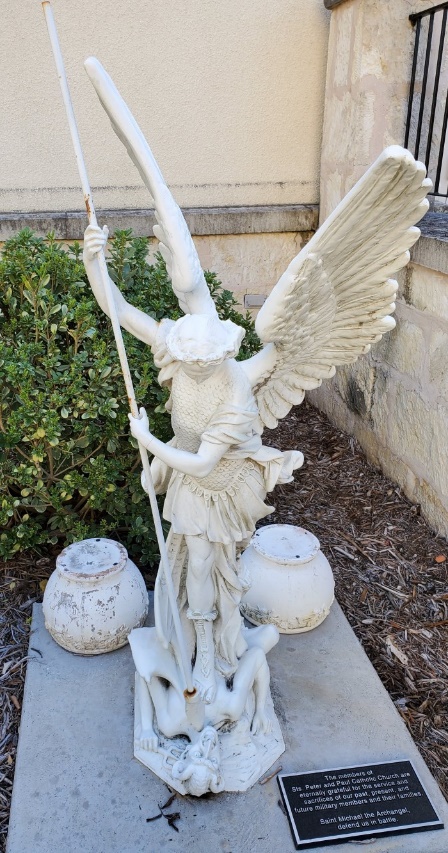 So we turn instead to the One who has already defeated these dark forces, and we sign up as members of His army. We turn to Jesus Christ, who broke the power of Satan, and we align ourselves with His victory. We look to Him not only as our example and guide, but also as the supernatural source of spiritual energy and strength.
We align ourselves with His victory by putting ourselves into Christ, His cross, and His resurrection. This is what Saint Paul means when he writes, “’Are you unaware that we who were baptized into Christ Jesus were baptized into his death?’” (Rom.6:3). He repeats, “’we were baptized into Christ’” (Gal. 3:27). We have “’put on the Lord Jesus Christ’” (Rom. 13:14). Jesus Christ is “’in us’” (see 2 Cor. 13:5). This is not just a metaphor, a symbol, or a religious way of speaking.
It is a reality.
We really have been plunged into Christ and into the victory He won 2000 years ago.
Jesus taught the same lesson: we are to live “’in Him and He in us.’” He is the vine, and we are the branches. If we remain in him, we will bear much fruit, but without him we can do nothing.
The power unleashed by the death of Christ lives in us. We have His spirit within us so that we can remain in Him and He in us.
To live in this faith is to abide, day by day, in the victory of Christ over evil. But remembering His victory is completely one with His being a victim, we also see that to live in Him is to live in the Lamb of God – and to live in the Lamb of God, we must walk in the Way of the Lamb.
The way of the lamb is the way of forgiveness – first for ourselves and then for others. This Way of the Lamb begins by a apprehending the mystery of the Lamb and His mission – at the depth of our being…”
